TPO, HEMA… These rather intimidating acronyms were at the heart of the gel polish debate for years, before being banned or strictly regulated in Europe. What risks do these substances pose, and how can you spot them to make sure you’re choosing a TPO and HEMA free nail polish? Here’s a practical guide to choosing a non toxic gel polish with complete peace of mind.
In short: which brand makes TPO and HEMA free nail polish?
- TPO, used as a photo-initiator in gel polish formulas, has been banned in the European Union since 1 September 2025. The reason: its toxic effects on reproduction.
- Methacrylate monomers (HEMA and Di-HEMA TMHDC) were long used as film-forming agents in gel polishes. Recognised as contact allergens, their use has been strictly limited and reserved for professionals since 2021.
- Before buying a new polish or booking a salon appointment, check the INCI list and look for the names of the substances to avoid.
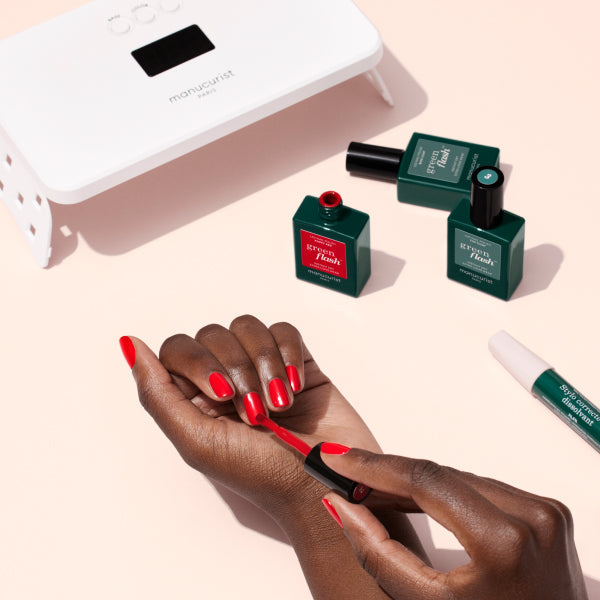
- Green Flash™ is a TPO and HEMA free nail polish, using copolymers and TPO-L instead, for a healthy manicure with no compromise on performance.
TPO and HEMA: two substances not to be confused
They’re often mentioned in the same breath, yet these two substances play completely different roles in gel polish formulas, and they don’t have the same regulatory status either.
TPO, a CMR photo-initiator banned in the EU
TPO (full name Trimethylbenzoyl Diphenylphosphine Oxide) is a photo-initiator. What does that mean in practice? It’s the ingredient that reacts to the light of a UV or LED lamp and triggers the hardening of the polish. Without a photo-initiator, there’s no curing: the gel polish stays liquid, and you can say goodbye to that lovely hard, glossy film over your nail!
Under scrutiny from European health authorities for around ten years over suspected reprotoxic effects, TPO was tolerated in products up to a maximum concentration of 5%. Since 1 September 2025 and the entry into force of European Regulation (EU) 2025/877, known as “Omnibus VII”, it has been banned in cosmetic products within the EU. Polish formulas that contain it can no longer be:
- placed on the market;
- made available, including to professionals;
- used in salons.
To understand this change in full, read our more detailed article on why TPO is banned in Europe.
HEMA, allergenic monomers to be handled with care
HEMA (hydroxyethyl methacrylate) and its cousin Di-HEMA TMHDC are methacrylate monomers. These are tiny, highly reactive molecules that bond together under the lamp to form the familiar “gel” film of a gel manicure.
These monomers are certainly effective, but they can penetrate the skin, especially when polish spills onto the cuticles or isn’t properly cured. It’s a risk also recognised in other industries where HEMA is used and handled with suitable protection, such as dentistry, plastics manufacturing and printing.
Since September 2021, European Regulation (EU) 2020/1682 has strictly regulated their use:
- Nail products that contain them can no longer be sold to the general public.
- Their use is reserved for professionals.
- Their label must carry two mandatory statements: “For professional use only” and “Can cause an allergic reaction”.
👉 Key takeaway: polishes containing TPO are banned for everyone, while polishes containing HEMA are reserved for professionals under specific conditions of use (protective equipment, ventilation, etc.).
Why avoid TPO and HEMA?
Banned or regulated, yes… but not entirely gone from our drawers (or from resale platforms). Here’s why it pays to stay vigilant:
TPO is classified as CMR category 1B, which means its toxicity to human reproduction and embryonic development is established, as shown by several toxicological studies and by the Scientific Committee on Consumer Safety’s 2025 safety assessment.
☝ While TPO no longer has a place in any cosmetic sold in Europe, a bottle bought before September 2025, or outside the EU, may still contain it. So we recommend giving your polishes a quick check! If an old gel polish lists “Trimethylbenzoyl Diphenylphosphine Oxide” among its ingredients, it’s best to get rid of it by taking it to a collection point rather than throwing it in the bin.
As for HEMA, it’s a contact allergen with a cumulative effect. Skin becomes sensitised a little more with each application, especially when polish spills onto the cuticles or doesn’t cure properly (unsuitable lamp, exposure time too short). And once an allergy has developed, it’s hard to shake off. Then there’s the issue of removal. Monomer-based formulas are usually removed with acetone, along with sanding or filing, which weakens the nail plate.
👉 So if you’re having your nails done in a salon and want a monomer-free polish, don’t hesitate to ask your nail technician for details about the ingredients in the products they use. A good professional should automatically check the INCI list of every product they work with.
☝ Watch out: a “HEMA free” gel polish isn’t necessarily a monomer-free polish. Some formulas simply replace HEMA with other methacrylates from the same family that are still permitted. Which is why it’s worth knowing how to read a label, and that’s exactly what we cover below.
And if you’d like to know which everyday habits to adopt, our guide to the least harmful nail polish is the perfect complement to this topic.
How can you tell if a nail polish contains TPO or HEMA?
The good news: you don’t need a chemistry degree to sort the good from the bad! All you have to do is read the INCI list.
Reading the INCI list
The INCI list is the official list of ingredients in a product, and it’s mandatory on all cosmetics sold in Europe. You’ll find it on the packaging, the leaflet or the online product page (much easier to read than the tiny print on a 15ml bottle, we’ll grant you). Ingredients are listed in descending order of concentration, and each substance has a unique international name. That’s the name to look for, not the acronym!
💡 Good to know: If the label carries the statements “For professional use only” and “Can cause an allergic reaction”, it’s a sign that the product very likely contains HEMA or Di-HEMA TMHDC.
The names to look for to avoid HEMA and TPO
Here are the molecule names to look out for on INCI lists to make sure you’re buying a TPO and HEMA free nail polish:
| 🧪 Name to look for | ⚖️ Status | ⚠️ Health risks | 🔀 Alternative | |
|---|---|---|---|---|
| TPO | Trimethylbenzoyl Diphenylphosphine Oxide | Banned in the EU since 1 September 2025 | Reprotoxic, classified as CMR category 1B | TPO-L (Ethyl Trimethylbenzoyl Phenylphosphinate) |
| HEMA | HEMA (Hydroxyethyl Methacrylate) | Sale to the general public banned Reserved for professional use since 2021 |
Allergic dermatitis, respiratory discomfort, asthma | Copolymers (Bis-HEMA Poly(1,4-Butanediol)-9/IPDI Copolymer) |
| Di-HEMA TMHDC | Di-HEMA Trimethylhexyl Dicarbamate | Sale to the general public banned Reserved for professional use since 2021 |
Allergic dermatitis, respiratory discomfort, asthma | Copolymers (Bis-HEMA Poly(1,4-Butanediol)-9/IPDI Copolymer) |
Safe alternative ingredients (TPO-L, copolymers)
A gel polish needs a photo-initiator and ingredients that harden under the lamp to form the solid, glossy layer you expect. The good news is that both of the problem ingredients we’ve just covered have safe alternatives:
- TPO-L (Ethyl Trimethylbenzoyl Phenylphosphinate): a safe, stable photo-initiator, not classified as a CMR or an endocrine disruptor, which allows the polish to cure under an LED lamp.
- Copolymers (Bis-HEMA Poly(1,4-Butanediol)-9/IPDI Copolymer): non-volatile chains of molecules, larger than monomers, which have the same film-forming properties under an LED lamp but don’t cross the skin barrier and don’t trigger allergic reactions.
Green Flash™, the TPO and HEMA free nail polish
At Manucurist, we didn’t wait for the regulations to clean up our formulas (and we’re proud of it!). Since day one, the brand has been committed to more responsible beauty, with formulas that are safe for your nails.
A pioneering brand, always ahead of the regulations
Launched in 2019 after more than a year of research, Green Flash™ gel polish was designed from the very start without HEMA or Di-HEMA TMHDC, two years before the 2021 European regulation took them off sale to the general public. The same goes for TPO: our laboratory ruled it out from the earliest stages of Green Flash™’s development, long before the 2025 ban, opting for TPO-L to create a TPO free nail polish. Behind every bottle lies real research and development work to:
- identify every potentially problematic ingredient and replace it with a safe alternative.
- replace petrochemical ingredients with ingredients derived from plant-based raw materials such as cassava, cotton, sugar cane, corn or wheat.
To discover what makes our formulas unique, dive into our article Green Flash™: what makes it different from the rest? or our guide to the best bio-sourced gel polish.
A manicure with no compromises
And what about the results? Green Flash™ means:
- A formula with up to 84% ingredients of natural origin, vegan and made in France.
- Over 120 nail polish colours, from everyday nudes to the boldest shades.
- A three-step routine in one complete kit with base coat, colour, top coat and LED lamp.
- Wear time of up to 12 days with the Green Flash™ Top Coat or 21 days with the Xtrem Flash™ Top Coat.
- Removal with no sanding or acetone, in 1 to 2 minutes per hand with the Green Flash™ Gel Polish Remover (allow 10 minutes for an Xtrem Flash™ manicure).
💡 Did you know? Because copolymers form a less dense network than conventional monomers, Green Flash™ comes off gently, with no scraping or filing of the nail plate. Your natural nails stay beautiful, so you can enjoy a few days of perfect bare nails between manicures.


The bottom line: to find a TPO and HEMA free nail polish, the INCI list is what you can count on. Look for the right names, steer clear of monomers and choose a brand that anticipated the regulations rather than scrambling to catch up. With Green Flash™, you keep all the wear and shine of gel polish, with no compromise on the health of your nails! You now know how to decode a label like an expert… so over to you 💅✨!