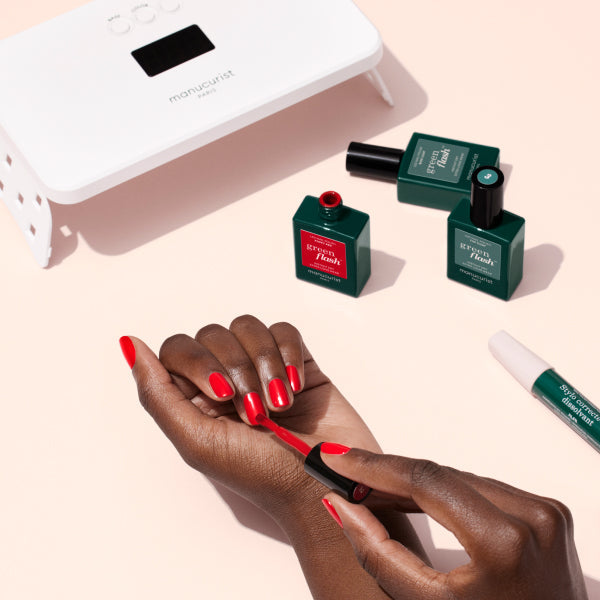
Found in most traditional manicure routines, acetone is the most widely used nail polish remover in the world, yet it remains one of the least understood. We apply it automatically, without fully considering its impact on nail keratin or the skin. On one hand, it is undeniably effective at removing gel and Gel Polish formulas. On the other, it can cause significant dryness. It is therefore time to take a closer look at this particular solvent, understand the risks of using it, and explore how to avoid it.
What is acetone and what is it used for?
Acetone is an organic solvent from the ketone family, naturally present in the body in small quantities and produced on a large industrial scale. Colourless and recognisable by its distinctive scent, it is one of the most effective nail polish removers available in the beauty industry. Its main cosmetic use is for removing nail polish, although it is also found in certain household products designed to dissolve, degrease and clean.
Why does acetone dissolve nail polish?
Nail polish is made up of film forming polymers such as nitrocellulose, resins and plasticisers which create a rigid coating once dry. Acetone works by breaking the intermolecular bonds within these polymers. It disrupts their structure and makes them soluble, allowing nail polish to be removed in just a few seconds. This is why it is so effective on even the most resistant formulas.
When should you use it: regular polish, gel or extensions?
For regular nail polish, acetone is not always necessary and a gentle remover may be enough. However, it becomes essential when removing traditional Gel Polish or gel, whose dense polymer structure is resistant to milder solvents. It is also commonly used to remove gel or acrylic nail extensions, which are often applied with adhesives or resins that only acetone can properly soften. For this reason, its use should be reserved for situations where gentler alternatives are not effective.

Acetone remains the most popular product for removing nail polish.
Is acetone dangerous for nails and skin?
Acetone is not classified as a CMR substance, meaning carcinogenic, mutagenic or toxic to reproduction. When used occasionally and externally, there is no significant absorption through the skin. However, frequent use can become problematic due to its intense drying power, especially for nails and skin that are already fragile. This is even more relevant if you suffer from chronic skin conditions such as eczema or psoriasis, or if your nails are already soft or damaged. :contentReference[oaicite:0]{index=0}
The effects of acetone for nails: dryness, weakness and breakage
While dissolving polish, acetone also strips away the lipids naturally present within keratin. Without this protective oily layer, the nail loses part of its natural defence system and becomes vulnerable to dehydration and disruption of matrix function. Keratin production may be affected and nails can become dull, soft, brittle or ridged. These warning signs indicate that it is time to rethink your manicure routine and provide your nails with the care they need to regain strength, shine and resilience.
The effects of acetone on skin: can it cause irritation?
The same applies to the cuticles, the delicate skin surrounding the nail plate. Acetone on skin dissolves the protective hydrolipidic film, which can lead to tightness, dryness and sometimes redness, particularly for people with sensitive or reactive skin.
How often can acetone use become a risk?
There is no universal answer, as it depends on the initial condition of your nails and skin. In general, the more frequently you alternate between polish application and removal without giving your nails time to recover, the less opportunity they have to regenerate and the greater the risk of long term nail weakness.
👉 As we often say, adopting a sustainable manicure routine is essential. Choose products that respect the health of the nail and include regular periods of rest and nail care between manicures.

Frequent and aggressive polish removal can gradually weaken both nails and cuticles.
With or without acetone: how can you remove polish or gel without damaging your nails?
How should acetone be used to remove traditional gel or Gel Polish?
The most effective and least traumatic removal method involves lightly buffing the top layer of gel using a fine grit nail file or Buffer sponges, without reaching the natural nail. The goal is to allow the acetone to penetrate the polish layers more effectively and dissolve them.
Next, soak small pieces of cotton in pure acetone and place them on each nail. Wrap each fingertip in aluminium foil to keep the cotton in place. After ten to fifteen minutes, gently lift away the softened gel using an orange wood stick, without forcing it.
⚠️ Do not scrape away stubborn residue, as this can damage the keratin layers of the nail. If some gel remains, simply repeat the acetone application.
A few simple steps can significantly reduce the impact of acetone for nails:
- Protect the skin around the nails with a rich cream or petroleum jelly before application.
- Work in a well ventilated space. In high concentrations, acetone vapours may irritate the respiratory tract.
- Do not exceed the recommended exposure time, as this increases dryness without improving results.
- Apply a cuticle oil immediately after removal to replenish lost lipids.

If you use acetone, take steps to prevent dryness in both nails and cuticles.
Are gentle acetone free removers really effective?
Acetone free removers mainly rely on alternative solvents such as ethyl acetate. Their main advantage is that they are less aggressive towards the lipids found in keratin than acetone, helping preserve the nail's flexibility and hydration. Many formulas also contain plant oils to help counterbalance the drying effect common to all solvents.
Their effectiveness depends on the type of polish being removed:
✅ For regular nail polish without a gel finish, although removal may take slightly longer than with acetone.
❌ For traditional Gel Polish, UV gel or acrylic resin systems.
✅ For plant based nail polish formulas such as Manucurist Green™ nail polishes and Green Flash™ Gel Polish. Thanks to their predominantly natural composition rather than a synthetic one, these next generation formulas eliminate the need for aggressive removal methods such as acetone and filing, which can weaken nails.

With Green Flash™, discover the pleasure of peel off style removal.
The Green Flash™ Remover, which is 96.5% plant based, acetone free and enriched with castor oil, removes all Manucurist polishes gently in just 1 minute (10 minutes for Top Coat Xtrem Flash™) while hydrating the nail plate. The result is a perfectly preserved natural nail, with no signs of damage or dryness.
👉 Explore the full range of Manucurist removers on our dedicated page.

How can you repair nails affected by acetone?
The best treatments to nourish nails and cuticles
Nails exposed to repeated acetone removals are often dehydrated. The priority is therefore to restore their lipid and moisture balance. A restorative routine combining S.O.S. Base and S.O.S. Mask helps deeply rehydrate the nail and revitalise the surrounding skin in just 2 weeks.
At the start of each week, file and gently buff your nails using a fine grit file and Buffer sponges. Then apply S.O.S. Base every two days without removing previous coats. At the end of the week, remove the accumulated layers using a gentle remover and apply S.O.S. Mask before bed. Leave it on overnight and peel it off the next morning, or remove it with a little soapy water if necessary.


Treatments enriched with nourishing plant oils, plant keratin, biotin and vitamins C and E can also support nail and cuticle regeneration. To enhance your recovery routine, consider adding:
- Nourishing Cuticle Oil, applied daily with a gentle massage over nails and cuticles.
- Nail Strengthening Serum, applied one to three times daily for seven days, allowing it to dry completely between applications.
- Nourishing Nail Pen, used whenever your nails need an intense and continuous boost of hydration.


Acetone is not a product to use lightly and should always be handled with care. The most important things to remember are:
👉 use it only when truly necessary, such as for removing gel or acrylic enhancements and traditional Gel Polish,
👉 avoid using it too frequently to minimise its drying effects,
👉 adopt a gentle manicure routine that respects the long term health of your nails.